














When you think of teachers and the things that go along with them, books often come to mind. They are practically synonymous with each other, but what would teachers consider the best genre?
Favorite Genres
The best way to start would be to see their personal favorite genres. The answers to this question varied widely with an even mix of fiction and nonfiction. The two who favored nonfiction were both the AP United States History teachers, Mr. Jeror–who also teaches Global 2–and Mr. Anderson–who also teaches AP Macroeconomics.
More specifically, Mr. Jeror prefers historical nonfiction. “It’s applicable to what I teach and [I] have a lot of interest in different historical events and stories,” Mr. Jeror reasoned.
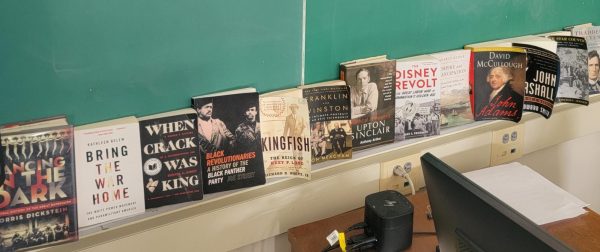
Not to say that the widely popular Mr. Jeror would lie, but there is evidence of his stated reason all around his room with a bookshelf full of different types of books that discuss all manors of history, and on his long chalkboard he has even more historical nonfiction books on display as well as one on his podium that is most often the one that he is currently reading.
Mr. Anderson’s answer is more nuanced. He was only placed into the nonfiction category because that is what he most often reads due to his job as an APUSH teacher, and that it would actually be difficult for him to choose a favorite genre.
“I’ve dabbled in Science Fiction, Humor and general novels, though I can’t say I’ve spent much time reading Romance novellas,” Mr. Anderson said to expand on his answer.
On the other side of the coin are two English teachers, Mrs. Clive–who teaches English 12, English 11, and Journalism–and Ms. Cissi–who teaches AP English Language. While Ms. Cissi’s answer is more complex, they both generally favor the fiction genre.
Ms. Cissi specifically enjoys 20th Century novels and poetry, both not being explicitly fiction but most often are“…a lot of modern literature experiments with language and I like that… I think it’s cool to experiment with different times of literature.”
Her reasoning can be shown through the novels that she has her APLang students read, most explicitly through The Scarlet Letter by Nathaniel Hawthorne, Grapes of Wrath by John Steinbeck and Jane Eyre by Charlotte Brontë.
“A close second would be poetry.. I love poetry,” Ms. Cissi added. This addition also makes sense because one of the first things she has her APLang students do is read a poem about a red wheelbarrow.
Mrs. Clive, on the other hand, gravitates towards realistic fiction, but she focuses more so on characters rather than genres.
“I think I really like a good story rather than a genre. My favorite books have a memorable story or a memorable character,” Mrs. Clive explained. “I like it when a book gives me some new insight about how people live their life… I like learning about how someone else experiences the world.”
Her view is also backed up by what she teaches, specifically Into the Wild by Jon Krakauer, The Great Gatsby by F. Scott Fitzgerald and Mice of Men by John Steinbeck, which are all intriguing stories that cover different types of living, either completely true and an unpopular way of living (such as Into the Wild) or based on the time period that it was written in from the perspective of the fabulously wealthy (such as The Great Gatsby). And while I have not personally read any of these books, I can only imagine how memorable the stories and characters are purely because of how popular the books are, The Great Gatsby even being a famous example of the Gilded Age.
Strange Answers to a Strange Question
Next up are their answers to a very specific question. The question being: “When asked what specific book to read in said genre by a stranger on a street, what would your response be?” The answers that the teachers provided vary greatly to the point where they cannot be put into vague groups like the previous topic.
When Ms. Cissi was asked this question, she gave a short and concise answer: “The Great Gatsby. One of my all time favorites.” This goes along with her previously stated favored genre being 20th century novels and the experimental nature of said genre as well as more contemporary novels.
Mrs. Clive answered much differently, posing two contemporary books when compared to The Great Gatsby. Specifically she recommended Remarkably Great Creatures by Shelby Van Pelt and A Man Called Ove by Fredrik Backman for the theoretical stranger. “It was really unusual because the octopus narrated part of the book,” Ms. Clive explained about Remarkably Great Creatures. She also enjoyed A Man Called Ove because of the complexity of the main character and the wide range of emotions that the book explores.
Mr. Jeror was next, a unique answer compared to the two that have been detailed so far. “No specific recommendation, just something that you can enjoy and feel some sort of connection to that encourages a love of reading,” Mr. Jeror explained, possibly giving the most generic answer possible. However, if you do not think too hard about the question or the theoretical situation, it is generally good advice.
And saving the most… unique… answer for last, there is Mr. Anderson, who answered the question like no other person has (likely with the help of his degree in sarcasm) to the point where I cannot make myself paraphrase his words.
“Most likely, I would imagine my response would be: ‘Why, hello stranger, how is your day? You’re probably the first person I’ve ever met to ask what my favorite book is before introducing yourself. Do you like cats? What’s that? My favorite book? Oh, I have many. I’m partial to The Road to Character by David Brooks or Cannery Row by John Steinbeck,’” Mr. Anderson answered. His answer differs from what he gave as his answer to the first question–granted, it was what he read the most and he does not have a particular favorite–that being nonfiction.
Favorite Author?
When you’re an avid reader you tend to have favorite genres. But you are also likely to have favorite authors as well. In this part, just like the subtitle says, we will be getting the answer from our participants on who their favorite authors are.
First up is Ms. Cissi who gave, once again, a sweet and concise answer. Her favorite authors, if she had to choose, are Jane Austen–the author of the famous novel Pride and Prejudice–and Tony Morrison–who wrote Beloved which is covered in APLang. These answers, once again, go back to her initial preference for unique writing, which Pride and Prejudice certainly has because of the era that it was written in.
“It’s like picking a favorite kid,” Ms. Clive answered. She then also agreed with Ms. Cissi that one of her favorite authors would have to be Tony Morrison. “I think she’s a really talented and powerful writer,” Mrs. Clive explained. She also expressed her love of Zora Neale Hurston’s writing, calling it ‘vivid’ and ‘engaging.’
“I don’t know, she just has a way of describing things where I can picture it,” Mrs. Clive expanded.
Mr. Jeror also gave a short answer for this question, though he specified the difference between the two authors. His favorite novelist would be Ernest Hemingway, who is infamous for his story The Old Man and the Sea which uses a large amount of repetition. His favorite historian is H.W Brands who focuses on American history, with a popular book of his being America First: Roosevelt Vs. Lindbergh in the Shadow of War which is about America before World War II and the debate over joining in the war or not. This period is prevalent in American history because America was still largely anti-war because they fought in World War I without being involved in the matter, but this time America was affected, specifically by Japan striking Pearl Harbor.
Mr. Anderson, surprisingly, gave a short answer as well and expressed that he favors the topic over the author. I say that it’s surprising that his answer was short not only because of his previously long answers, but also because he tends to talk a lot during class–which I would too if I was a teacher teaching a topic that I enjoyed.
What Books–In an Ideal World–Would You Cover In Class?
Once again, a weird question. Though, from a totally unbiased perspective, I think that it’s more unique and thought provoking than weird. Anyhow, let’s get rolling.
First, like the previous few times, is Ms. Cissi. She specifically mentions Beloved by the previously mentioned Tony Morrison, but notes that she already covers that in her APLang class–and is likely covering it by the time this article is published. She cites strong writing and important lessons about American history, specifically about slavery. The next book she gave was The Great Gatsby by F. Scott Fitzgerald. “…because it’s all about now. It’s so relevant. The message never gets old,” Ms. Cissi explained. I have to agree with her on this choice, especially with the extremely out of touch Great Gatsby themed party that President Donald J. Trump had early last year while SNAP benefits were being taken away because of a government shutdown–which only adds to the irony.
The next book she was less specific with and only said a Jane Austen novel. “[they have] insightful characterization and [are] incredibly relevant even though they were written almost 200 years ago,” Ms. Cissi said. As a person who has never read any of Jane Austen’s novels, I may not be entitled to say this, but I watched a version of Pride and Prejudice with my mother and, though I do not like romance, the characterization was immaculate.
Mrs. Clive expressed that she enjoys all of the books that she teaches, so the problem is more about having time to teach specific books or literature.
“I used to teach Hamlet but we switched to Hamilton. Ideally I would like to teach both of them,” Ms. Clive expanded. She also said that she would enjoy teaching Great Expectations by Charles Dickens, but the issue is the length of the book and the older English that Dickens uses.
Mr. Jeror, once again, gave a shorter answer. But I believe that he put it perfectly and his answer doesn’t need much more explanation once you get to know him. “Generally speaking any cultural or social history in the 20th century and topics that we don’t get to spend a lot of time and depth in class,” Mr. Jeror said. And as somebody who has taken both of the classes that he teaches, I can only agree and would love to see Global 1 or APUSH incorporate topics that are generally brushed off or do not get much of an in-depth analysis.
Mr. Anderson gave a short answer as well. “I’d love to teach a history class that relied only on a textbook and a series of autobiographies,” Mr. Anderson explained. Mr. Anderson seems to have a love of textbooks, from wanting to force his students to read them even in an ideal world to having old textbooks put together in the back of his classroom to pull out and mention in the middle of a lecture how different textbooks nowadays are in how they express facts, with the older ones seeming to be more opinionated than the modern ones.
What Is The Best Book Genre?
Finally on to the question that everyone has been waiting for. And if you read all this way expecting a surprising answer–like Mr. Anderson claiming that romance is the best–then I’m sorry to disappoint, because these answers are similar to the rest.
Ms. Cissi gave the answer of the novel genre, which may seem generic at first glance but her reasoning is much more in depth, and I wouldn’t be able to put it any other way, so I’ll–once again–give you the full quote.
“Novels can entertain, distract, reflect life as we know it or life as we hope it could be. They can play with our expectations, teach us, and take us outside of ourselves. They can also speak [the] truth and save lives. I know this sounds esoteric, but this is why I read and write. And this is why I became an English teacher,” Ms. Cissi answered. I would usually add commentary here, but there is nothing more for me to say in this regard.
Mrs. Clive said that she couldn’t choose, but tends to enjoy literary fiction, dystopian novels, novels with “quirky characters” and coming-of-age stories.
Mr. Jeror gave a different answer that has not been seen yet, that being one of my personal favorites, fantasy and its sub-genres.
“It offers escapism while simultaneously delving into complex themes and issues that reflect our own societies and personal experience,” Mr. Jeror explained.
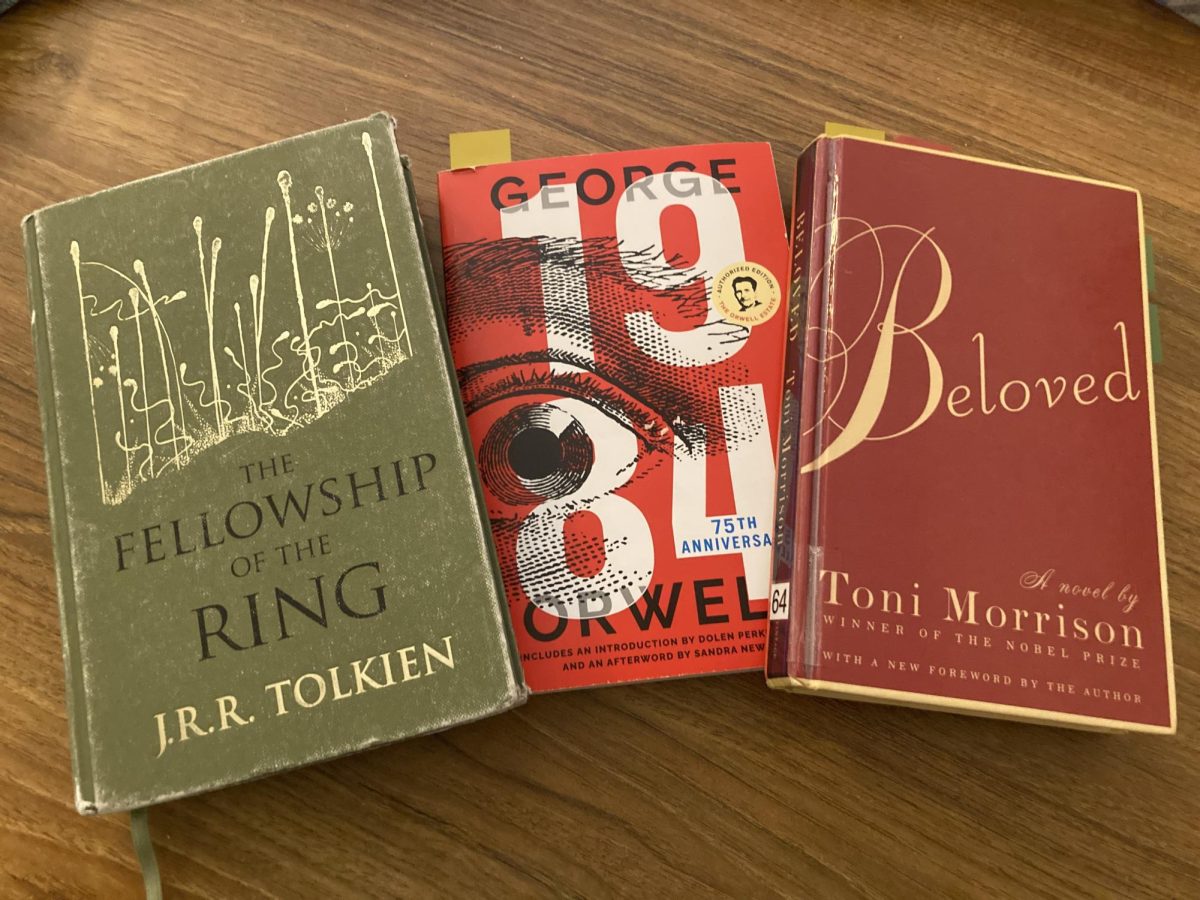
While I may be considered a novice on books, tending to spend my free time more on video games, my most favorite book that I’ve read was The Hobbit by J.R.R. Tolkien and–when I find the time–am also reading The Fellowship of the Ring by Tolkien as well. Both of these are extremely famous for a reason, and, like Mr. Jeror stated, reflect the issues in our own societies with The Hobbit even being an allegory for World War I as well as a story that he wrote for his kids.
Mr. Anderson pulled out the “it depends” card on this one, but he still makes good points. If the reader is looking for an escape from reality, the best genre might be science fiction. But another reader could be looking for an introspective, leaving the best fits–in his opinion–to be a “coming of age” novel, historical fiction and nonfiction.
Conclusion
Though this is not a satisfying conclusion like you may have expected, it is still a conclusion. That being that the opinions of the selected teachers vary, but generally come to the consensus that fiction tends to be considered the “best” genre. Of course, do not let this make you feel bad about your favored genres, as there is no truly “best” genre, this was just something fun I had in mind that would be easy on my brain because of burnout from school. In fact, here are some of my personal recommendations for a few genres:
Romance: Delilah Green Doesn’t Care by Ashley Herring Blake (This is a YA sapphic love story, I really enjoyed it)
Dystopian: 1984 or Animal Farm by George Orwell (Both of these I find scarily close to our society right now)
Nonfiction: Everything Is Tuberculosis: The History and Persistence of Our Deadliest Infection by John Green (I enjoy these types of pieces that talk about a very specific thing but somehow are able to expand that small topic to the point of making it a whole novel)
Mystery: Any of Agatha Christie’s novels (I personally love her writing style, and also find the mystery about her disappearing for a time interesting)
Fantasy: Lord of the Rings trilogy by J.R.R Tolkien (I LOVE the trilogy and The Hobbit because it’s not only high fantasy, but it’s also written well unlike a lot of high fantasy novels nowadays)
Manga: Bungo Stray Dogs by Kafka Asagiri (Its writing is amazing and is not as popular as it should be in the manga space. All of the characters are based on real writers with prominent ones such as Fyodor Dostoyevsky, Edgar Allan Poe and F. Scott Fitzgerald, but they show up in the later portions. It deals with supernatural powers but isn’t the typical superhero versus super villain trope and is almost entirely morally gray. Sorry for the short rant, I just love this series so much)