













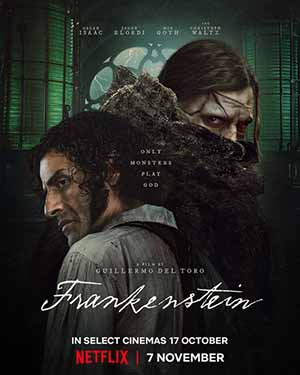






This article contains spoilers for the new Frankenstein movie
The story of Frankenstein’s monster has been told many times by now, but renowned director Guillermo Del Toro’s reinvention of the tale has been rapidly gaining attention after releasing on streaming just last month. Based on the iconic 1818 gothic novel by Mary Shelley, the movie is brought to life by Oscar Isaac playing a bitter Victor Frankenstein, Jacob Elordi as the naive creature, and Mia Goth as the sympathetic Elizabeth.
The movie provides context for forthcoming events with the scenes of Victor’s unfortunate childhood, portrayed as one of much darkness and pain. His father is depicted as abusive and unloving, so Victor is instead close to his kind mother. His mother is played by Mia Goth as well, a detail that gives closer look into Victor’s mental issues when he grows infatuated with Elizabeth later in the film. Sadly, Victor’s mother dies when he is a child as a result of an unsuccessful childbirth, though he suspects that his father took part in her death due to the fact that they had the best doctors in the palace, who in theory should have been able to save her. The baby survives and is named William, and is portrayed as a bright and cheery kid. Victor, on the other hand, is now miserable in the depths of his grief.
The damage to Victor’s psyche inflicted by his difficult relationship with his father and his motherless state proves itself to be a cycle with Victor’s poor treatment of his creation, which is his child in a way. Del Toro expresses a theme of generational trauma through these “father-son” relationships.
Guillermo Del Toro took an interesting creative liberty by discarding the murders committed by the creature as described in the book. The creature’s clear innocence in the movie highlighted Victor’s cruelty, showing how unjustified he was in his harsh interactions with his creation.
Mrs. Clive, an English teacher at the high school, read the book with her students years ago. She said that in the novel, (and previous film adaptations,) the creature kills a child. This is a stark difference to the pure, fairly harmless creature in the movie. She also told me that the theme is still consistent in the book and the new movie, despite the changes. Both provoke the reader/watcher to realize that the real monster in the story is Victor, not his creation. The lack of bloodlust and gentle nature in Del Toro’s version of the creature only amplifies this theme further, making it obvious that Victor is the “evil” one between the two. Mrs. Clive also noted that she appreciated the visual aspect of the movie, which used beautiful color grading and cinematography with gothic elements. She also mentioned the impressive performance of the cast.
Mary Shelley wrote the original Frankenstein Or the Modern Prometheus as a response to some of the aspects of the Enlightenment, critiquing those whom she believed were going too far scientifically and defying natural order. Del Toro embraces this theme in his movie, especially represented in the beginning scene where Victor Frankenstein shows off his invention to a crowd of fellow scientists. They warn him that what he is attempting to create is a dangerous abomination, that he should not try to create life out of scraps of other deceased humans. Victor does not listen, and eventually reaps the consequences.
Though it was written more than 200 years ago, Shelley’s novel has remained a timeless classic, but why? Guillermo Del Toro attributes the longevity of the tale to the perpetually relevant philosophical questions behind it.
“You know, it’s the same questions we have now: What are we? Why am I human? Why am I here?” he said in an interview with CBS news. The director also spoke to his love of stories about monsters, informing a reason why he connected with Frankenstein as a kid and why he is inclined to keep telling his own monster stories. “What is beautiful about monsters is they become patron saints of imperfection,” he said.
Del Toro described monsters like inspirational figures that told him it was okay to be himself and to be imperfect.
Elizabeth was also a significant character, and a fight over her love led to important conflicts in the movie. She immediately catches Victor’s eye when they meet, but she is engaged to his younger brother William. Of course, Victor’s feelings for Elizabeth are not reciprocated. The salt in the wound for him is later on when she meets his creation and forms an immediate connection to the pure creature. Del Toro describes the connection with the creature as Elizabeth “recognizing herself in it.” He even said that Elizabeth and the monster are “of the same essence,” explaining the deep empathy expressed between the two characters.
Elizabeth’s death was the creature’s breaking point, driving him to hunt down Victor on the ship and horrify the whole crew in the process. When he finds Victor, he surprisingly starts speaking coherently after a while of being away on his own, and he begins telling his side of the story, cutting to part two of the movie. I thought this was an interesting concept to incorporate into the movie, and the creature’s part was probably my favorite.
After a fire at the mansion sets him free, the creature runs off and meets an old blind man with a farm. Over time, the creature learns a lot from the blind man, and they develop a touching friendship. This plot line is a beautiful part of the movie, as the creature finally has a father figure of sorts who treats him kindly. The farm is ravaged by a vicious pack of wolves, who eat the sheep. The creature is heartbroken to find that the wolves got hold of the blind man as well, who is in critical condition after the brutal attack. The old man uses his final breaths to humanize the creature, with the words the creature needed to hear more than anything, even if he did not realize it.
“I know what you are. You are a good man. And you are my friend.”
One of my favorite parts of Frankenstein was the final scene between Victor and his creation. Victor begged that the creature say his name one last time – the name his father gave him, the name that he wished to reclaim. The creature is merciful and repeats the name, forgiving Victor for forcing him into the cruelty of his manufactured life. However, Victor’s sentiment about reclaiming his name seems ironic, because he never granted the creature a name of his own. Victor dies right there beside the creature, who proves in that moment to have more humanity than the human who made him.