

























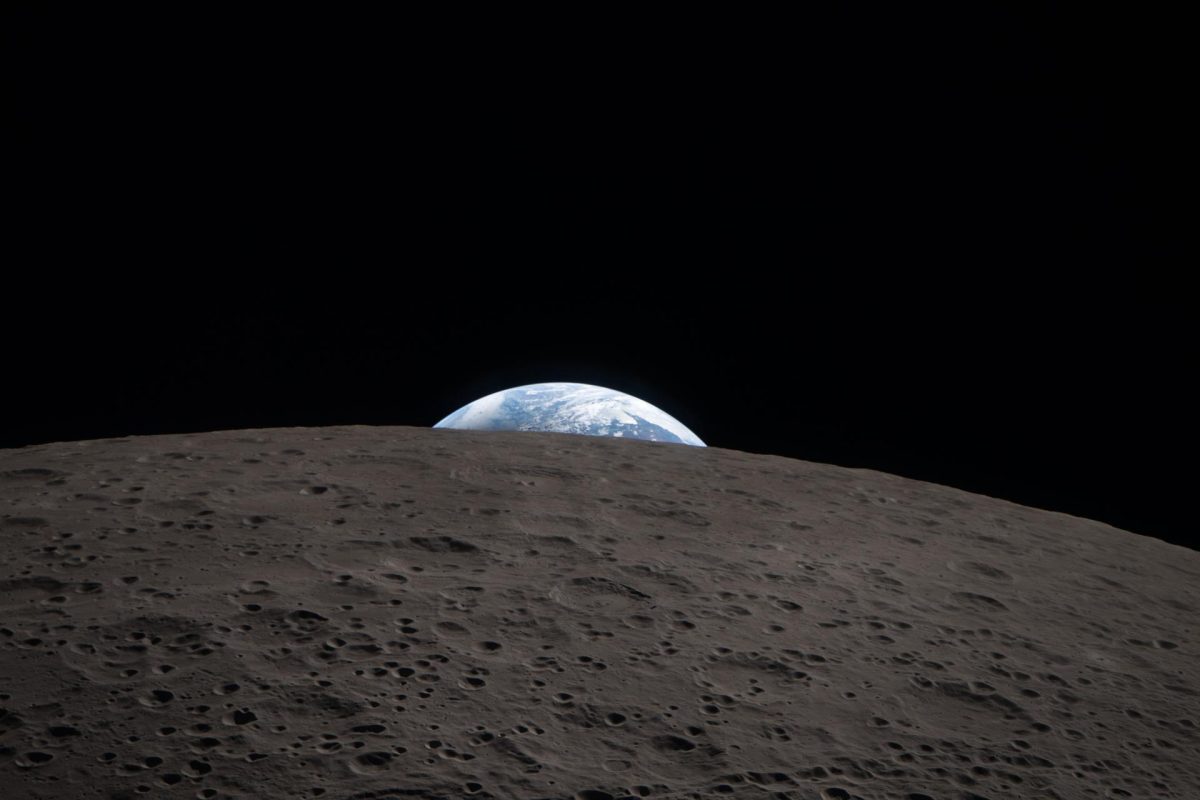
Humanity’s ambitious sights were first set on the Moon, but now they travel further; Mars is next.
Ever since we set foot on the Moon, we have been looking at Mars as our next target. The journey to Mars became within our reach the moment the Artemis Mission was set into motion. Artemis II is already widely talked about, specifically because humans have not been this close to the moon since Apollo 17 in 1972.
Many people may think that the Artemis Mission is only to get people on the Moon again, but it is much more than that. According to NASA’s official website, the Artemis Mission is to explore the Moon for scientific discoveries involving the formation of Earth, but also to begin the foundations of sending the first people to Mars.
The majorly successful Artemis II Mission was, in fact, only a test run of the Space Launch System and the Orion Spacecraft’s operation system to make sure that they were prepared for the Artemis IV Mission in 2028, where people are being sent back to the Moon for real.
According to NASA, the major reason as to why scientists have set their eyes on Mars is because it is the only planet in our solar system that had potential life on it, and we could learn about Earth’s past and future with Mars as a lookingglass into the future. There are also economical benefits that come with humans landing on a new planet.
However, some people feel like the importance of Mars has been inflated, and that it is not as important as NASA and the media makes it out to be. Mrika Syziu, a junior who is taking physics, is one of these people.
“I don’t think it’s important because we have so many problems here, y’know, on our home planet. What’s the point in investing so much funds into something that won’t have a very good, y’know, effect for most people,” Mrika said, adding that the funds should go towards helping people, not space exploration.
Mrika was then asked if she thinks that we should visit a different planet before Mars, and she agreed with NASA that Mars should be first because it is the most cost effective and practical.
“Can’t we just develop more, like, I dunno. Like, advanced unmanned technology, so we can just send them there instead of having some people which would cost way more,” she added.
Mrika was then asked if we should be looking at reviving sending people to planets instead of machines.
“I mean, I don’t think so because the world is collapsing. I feel like we should be investing more money into solving the problems here,” she answered. She then cited problems like war, starvation and the dwindling water supply in places such as California.
She was then asked if she thinks that we would find useful information about Earth on Mars. “I mean, I wouldn’t call it useful as in practically, but I would say that it would be, y’know, useful as in understanding [the] origins of life,” Mrika responded.
The next question was if she believed that humanity was bound to colonize Mars. “I don’t think we’re gonna make it…100 more years, personally. Things have just gotten worse and worse…We’re bound to go extinct. Our lifespan is quite short as a species…Most animals, most things have gone extinct.. We don’t have much [time] left…We’ve destroyed our planet,” she answered.
However, there are more optimistic people when it comes to humans exploring space. Brian Simmons Sr., somebody who is interested in scientific advancements, is one of these people. However, he takes the opposite stance of Mrika when asked if Mars should be the first place to travel to after the Moon.
“No. Mars is too far away, it’s going to provide very little scientific data versus other moons in the solar system…which we still could better probes to…Getting to the moon and establishing a permanent base there is much better for us to learn how to live on other planets without the risks, and still provides excellent chances to study many things about how our bodies behave in different environments and gravities,” he said.
Mr. Simmons expanded more on his point when he was asked if we should travel to other planets before Mars. He mentioned that he believed that we should spend more time on the Moon first, but then we should go to Venus.
“…From what I’ve seen and read, we could have humans living there in a similar gravity to what’s on earth, with similar air pressure and temperatures,” Mr. Simmons said.
Along with those reasons, he also said that Venus has more solar energy than Earth. He then proposed the idea that with the theoretical space station on Venus, we should skip Mars because obtaining energy there would cost much more than using solar energy on Venus.
Mr. Simmons was then asked if he believes that we should be reviving sending people to celestial bodies now, and he agreed. He did note that sending probes and machines is far less expensive to get scientific data from those planets, but added that without people on the celestial bodies, it would become “too academic.” Mr. Simmons then went on to explain more about why humans should be sent to the planets and moons.
“What was beautiful about the moon landing was the way people could connect with those men up there. They could dream down here because we’d gone there,” he said. Mr. Simmons then added that for the safety of humanity, we need to expand our reach into space and beyond our solar system, and that to do that we need to put boots on the ground again.
The next question was about if we will find out anything about Earth when we get to Mars. Mr. Simmons answered by saying that the priority when we get to Mars–instead of learning about Earth–will be to exploit the untouched natural resources of Mars; to set up a “staging area” to take advantage of the minerals and water in the asteroid belt; and to expand our exploration of the solar system.
To end it off, Mr. Simmons was asked if he believes that humanity is bound to colonize space, and if he believes that we will make it far enough away before the sun explodes.
“There’s not a realistic scenario where we will get all that far as things stand. But science changes, that’s the nature of science…Physics says that matter cannot travel at the speed of light, but there are objects in the universe traveling away from us faster than the speed of light. There are other suns out there, and time is very long compared to a human lifetime. Even if we just develop interstellar travel which takes generations to reach other inhabitable worlds…I think it’s possible. I’m hopeful that we take the best of ourselves out to the stars and not the worst of us,” he said.
Both of the interviewees made good points regarding the future of space exploration. On one hand, continuing space exploration will be good for humanity in the long run. On the other hand, some of the funds being used for space exploration should be focused towards helping the people now with things like healthcare, food stamps, or public works projects. This is not to say that space exploration is useless, but it is to point out that even issues such as these are not black and white.
The future of space travel is unknown for now, but we can always make educated guesses for what the future holds. The general consensus is that humanity will colonize space, but that it will take an eternity for it to happen. The only thing truly stopping us is our sun exploding on us, but that will not happen until billions of years in the future.
Currently the richest man on Earth, Elon Musk, is heavily interested in colonizing Mars specifically. Based on this, we can conclude that there will–theoretically–be enough funding to get us there. And if the large amounts of money going into funding space exploration continues, students now will be able to see humanity land on Mars within their lifetime.