























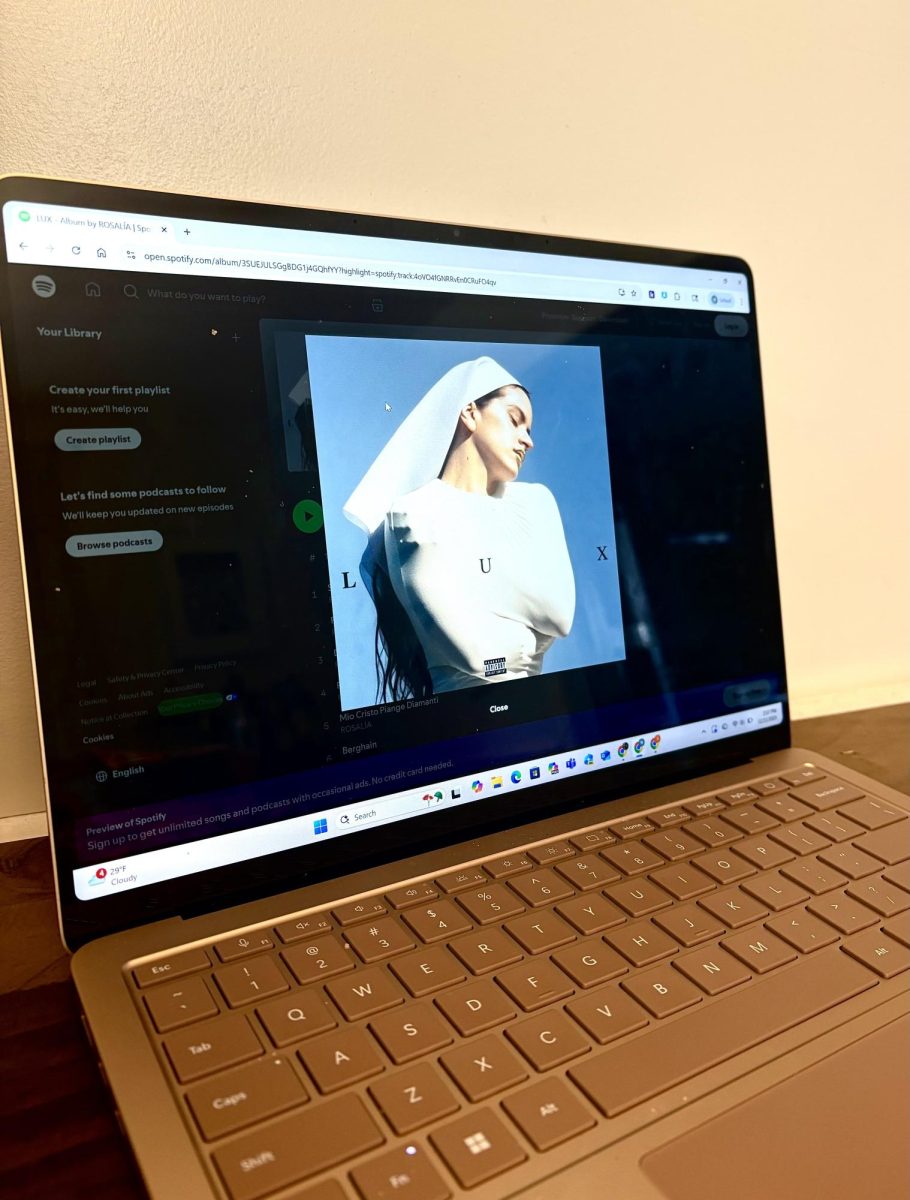
“I think the best fiction is the fiction that has this blurry line between what’s personal and what’s universal,” Rosalía tells Zane Lowe in an interview for Apple Music.
Released Friday, November 7th to overwhelming critical acclaim, LUX is the Catalan-born singer’s fourth studio album. But the project is a departure from Rosalía’s previous work.
“If you’re expecting ‘Con Altura’ you’re likely to be lost at first,” writes Gio Santiago for Pitchfork, referring to the pop-star’s 2019 collaboration with reggaeton singer J Balvin.
After experimenting with pop and musica urbana beats on Motomami–her celebrated 2022 record–Rosalía pivots to classical music and opera on LUX.
“Motomami was minimalist,” she explains to Lowe. “This is maximalism.”
Making effective use of her opera training from the Catalonia College for Music–one of the most prestigious musical schools in Europe, according to reports from Rolling Stone–Rosalía opts for classical production rather than traditional pop-synth tracks, and engages her intellectual curiosity with lyrics spanning 14 languages.
The result is nothing short of a masterpiece of modern music.
With storylines based on the singer’s interest in saints, she creates a holistic project that is meant to be listened to in one sitting. Not one song would feel quite right without the accompaniment of its adjacent tracks.
The singer told the New York Times that she wants fans to listen to the album on headphones, noting the inconvenience but emphasizing the act of appreciating the music in its entirety.
The classical composition, performed by the London Symphony Orchestra according to the BBC, provides the backdrop for an album filled with personal maladies intertwined with complex storytelling.
On ‘Reliquia’, vibrant string production backs lyrics recounting the singer’s laments of love and loss.
“Pero mi corazón nunca ha sido mío/yo siempre lo doy [But my heart has never been my own/I always give it away],” she sings in rising crescendos that evoke powerful emotion.
On ‘Porcelana’, she sings about a duality of fragility and power. The track uses Spanish, English, Latin, and Japanese lyrics and is inspired by 15th century monk Ryōnen Gensō who made great sacrifices to achieve her goals, Rosalía told Apple Music.
“Mi piel es fina/De porcelana [My skin is thin/Fine porcelain],” she sings softly before warning, “Yo tengo puedo inspirar/Te puedo envenenar [I can inspire/I can poison]”.
Duality, strength, and love are just some of the paradoxes LUX explores with powerful classical compositions and contradicting lyrics. Ultimately, the album tells the story of a transitory period of the singer’s life and doesn’t shy away from complexity in its approach.
Rosalía’s passion for musical composition and her intellectual curiosity are put on full display on LUX, and it might just be what makes it her best album yet.