








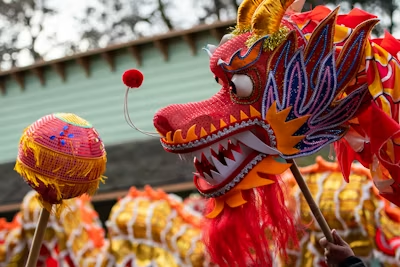
















The Dragon Boat Festival is a traditional Chinese holiday. The date of the Dragon Boat Festival is June 19th.Like the Spring Festival, it is an extremely important festival for the Chinese people.On this day, people celebrate the festival with great joy.
There are many customs associated with the Dragon Boat Festival, among which the most widely known are dragon boat racing, wearing scented sachets, and making *zongzi*.
Regarding the origins of the Dragon Boat Festival, most people believe it is celebrated to commemorate the patriotic poet.Qu Yuan was a patriotic poet of ancient China, was exiled after falling victim to slander. On the day of the Dragon Boat Festival, as invading forces captured the national capital, Qu Yuan—overcome with grief—clutched a stone and threw himself into the river to end his life.To protect Qu Yuan’s remains from being devoured by fish and shrimp, local villagers rushed out in their boats to drive the creatures away and cast bamboo tubes filled with rice into the river. This practice eventually evolved into the modern-day customs of dragon boat racing and eating *zongzi* during the Dragon Boat Festival.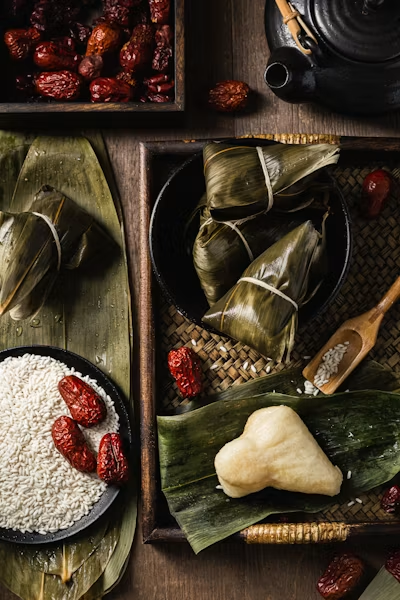
Zongzi is a food widely consumed by Chinese people during the Dragon Boat Festival. Modern zongzi can be broadly categorized into two types: the angular zongzi found in the North, and the cylindrical zongzi found in the South.Zongzi is a traditional Chinese food made from glutinous rice.Typically pyramid-shaped, they are wrapped in bamboo or reed leaves; the fillings range from savory to sweet, with common ingredients including pork, shiitake mushrooms, salted egg yolks, and various legumes.They are typically prepared by boiling or steaming. Zongzi are particularly popular during the Dragon Boat Festival.In China, there are people who enjoy spicy food, but I still prefer sweet things.Every year, my mother makes a large batch of *zongzi*—typically divided into savory meat-filled ones and sweet ones.Afterwards, my mother would share some of the zongzi with friends and family and invite them to have a taste.I will also help my mother make zongzi—that kind of work is truly exhausting.
In preparation for the Dragon Boat Festival, my mother begins by soaking dried bamboo leaves and cotton twine overnight; she then boils them in water for approximately 5 to 10 minutes to sterilize them, soften their texture, and prevent them from tearing. As for the filling: the long-grain glutinous rice is thoroughly rinsed and soaked for 1 to 2 hours before being drained. Alternatively, it may be lightly stir-fried with seasonings—such as fried shallots and soy sauce—to enhance both its color and flavor. Regarding other filling ingredients—such as pork belly and shiitake mushrooms—these should be marinated in advance to allow the flavors to fully penetrate.My mother generally prefers to put sweet dates or pork belly in her zongzi.Once the preparations are complete, we begin wrapping the *zongzi*. Take two bamboo leaves (placing the smaller leaf atop the larger one, with the smooth sides facing upward) and fold them in half crosswise at a point approximately two-thirds of the way down their length to form a conical, funnel-like pocket. Note: It is crucial to pinch a distinct crease at the pointed tip of the funnel’s base; otherwise, the glutinous rice will leak out from the bottom. Filling: First, place a tablespoon of glutinous rice into the bottom of the funnel and press it down slightly to compact it. Next, add a generous portion of fillings—such as chunks of meat, shiitake mushrooms, and salted egg yolks. Finally, add another layer of glutinous rice to completely cover the fillings. Sealing and Wrapping: Fold the excess leaf material at the top downward to cover all the rice, then tuck the leaves on the sides inward to tighten the structure, shaping it into a distinct, four-sided pyramid. Tying: Neatly fold the loose ends of the leaves against the body of the *zongzi*. While holding the *zongzi* firmly with one hand, use the other to wrap it several times with cotton twine, finishing with a slipknot; ensure the binding is tight to prevent the *zongzi* from falling apart during boiling.Once the zongzi are wrapped, they are ready to be boiled. Place the wrapped zongzi into a deep pot and pour in cold water (ensuring the water completely covers the zongzi). For me, wrapping *zongzi* is extremely difficult; on several occasions, I was unable to wrap them properly because I had added too much glutinous rice.Cooking Process: Bring the water to a rolling boil over high heat, then reduce the heat to a simmer, cover the pot, and cook for 1 to 1.5 hours to ensure that the glutinous rice and fillings are thoroughly cooked.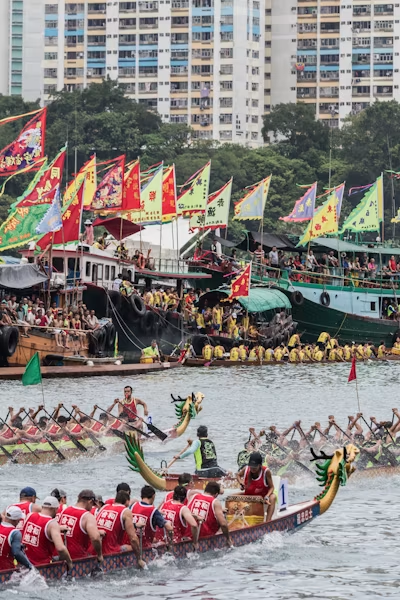
Dragon boat racing is a core folk custom of China’s Dragon Boat Festival, as well as a water-based competitive sport with a long history and profound cultural heritage.Typically, the drummer, helmsman, and paddlers work in close coordination, rowing vigorously in a race against time amidst the rhythmic beats of drums and gongs.In a few specific regions, dragon boat races are also held.Dragon boat racing is not only a folk celebration but has also evolved into a modern sport.
During the Dragon Boat Festival, my family gathers together to chat and wrap zongzi.In the evening, we would sit in front of the TV and watch the dragon boat races.This year’s Dragon Boat Festival is fast approaching, but I am already prepared to welcome its arrival.