










The Dragon Head Festival—popularly known as “The Dragon Raises Its Head” (Long Tai Tou)—is a traditional Chinese folk festival. This year (2026), the “Dragon Raises Its Head” festival falls on March 20th of the Gregorian calendar. According to historical records, this festival—fixed on the second day of the second lunar month (commonly referred to as “Er Yue Er”)—officially originated during the Yuan Dynasty. It subsequently gained widespread popularity throughout the Ming and Qing Dynasties, eventually evolving into a deeply cherished folk festival. It marks a season when all living things begin to revive. Insects, snakes, and wild beasts—which had lain deep beneath the soil during the long period of winter hibernation—now awaken from their slumber and emerge from the earth. According to legend, it is precisely at this time that the mythical “Dragon” also awakens from its deep sleep. On the second day of the second lunar month, the celestial asterism symbolizing the “Dragon’s Horns” rises above the eastern horizon; hence, this day came to be known as “The Dragon Raises Its Head.”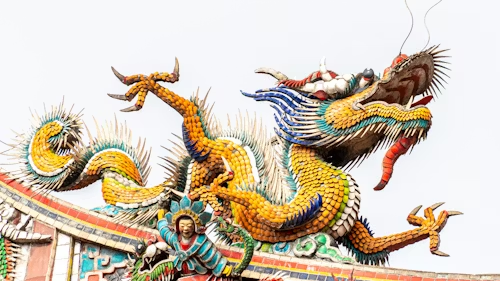
My grandmother, who resides in China, told me the origin of this celebration. It symbolizes the arrival of spring. Its profound significance lies in praying for favorable weather and bountiful harvests—embodying people’s hopes for a prosperous life in the coming year. This day marks the official commencement of agricultural production. The ancients firmly believed that, starting from this day, rainfall would become increasingly abundant, as the “Dragon King”—the deity who governs the rains—had awakened from his long winter slumber.
The most prominent custom on Longtou Street is getting a haircut.On this day, people cut children’s hair to pray for their healthy growth. For adults, a haircut serves as an expression of the hopeful wish for a smooth and prosperous year ahead. Furthermore, a folk belief persists—albeit one with a somewhat indirect connection—that getting a haircut during the first lunar month will bring misfortune upon one’s maternal uncle. Although few people today regard this notion as absolute truth, in the past, people firmly believed in it: they would deliberately refrain from cutting their hair throughout the entire first lunar month, waiting until the arrival of the “Dragon Raising Its Head” festival before flocking to barbershops to queue up for a haircut.
On this day, my mother cut the hair of my two younger brothers and my father. She wanted to cut mine as well, but I refused; I cherish my hair very much.In the end, I still only let her trim a tiny bit of my hair.
On this day, it is customary for people to eat noodles, griddle cakes, and dumplings. The meat filling inside the dumplings symbolizes “wealth.” Customs associated with this festival vary by region, differing from place to place. For instance, people may use wood ash to outline circular or square “granaries” in their courtyards or threshing floors, filling them with grain and other items to pray for an abundant harvest in the coming year. People also enjoy fried pastries, roasted beans, and twisted dough sticks. Northerners tend to favor meat and wheat-based dishes—such as braised pig’s head meat, soy-braised pork knuckle, dumplings, and spring pancakes. In the South, however, people typically consume shepherd’s purse rice (symbolizing the expulsion of dampness from the body) and *Chengyao Gao* (a type of glutinous rice cake intended to pray for a strong and healthy physique).These foods symbolize good luck and happiness. During this period, people not only consume flatbreads and noodles, but women are also forbidden from engaging in needlework. “Knocking the Dragon’s Head”—also known as “Summoning the Dragon”—is a folk custom in which people rhythmically strike the roof beams to drive away venomous insects; this practice symbolizes the awakening of the slumbering dragon, thereby serving the purpose of dispelling evil and inviting good fortune.
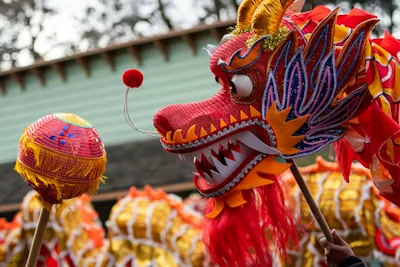
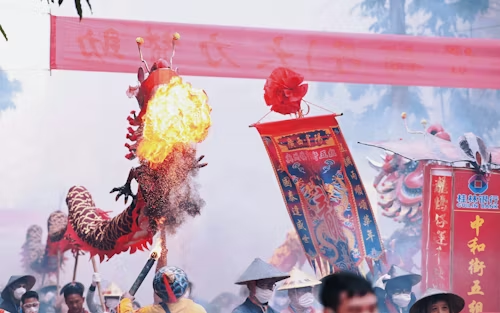
In China, I watched a dragon dance performance.This is a traditional folk art—a comprehensive performance that integrates martial arts, dance, music, and folk craftsmanship.The performance was very entertaining.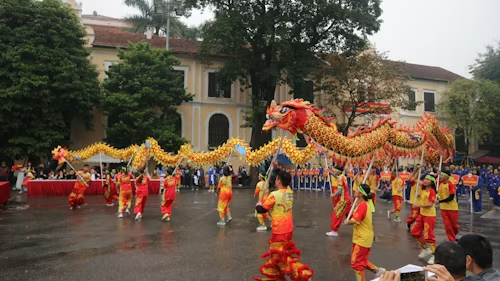
The Dragon Head Festival is not only the birthday of the folk “Earth God” but also a traditional occasion for holding sacrificial rituals. Furthermore, this day is closely linked to a custom known as “The Dragon Raises Its Head—Eating Pig’s Head.” Since pig’s head meat is frequently offered as a sacrifice to the deities, people believe that consuming it allows them to receive divine blessings and ensures their personal safety. All in all, these customs collectively embody people’s boundless yearning for a better life. To welcome this special day, my mother specifically prepared pig’s head meat. Additionally, she made *chunbing* (spring pancakes) and cooked a variety of other dishes, such as pig’s trotters.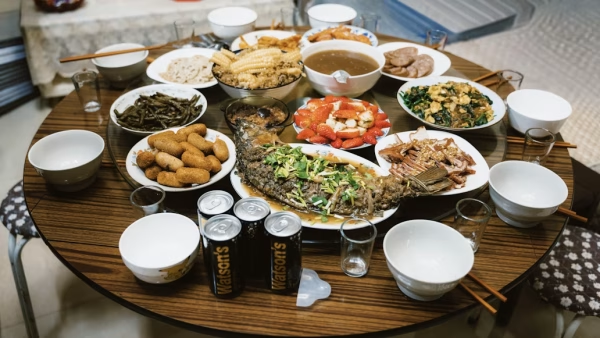
The Dragon Head Festival is the official commencement of spring plowing across the land of China—a traditional festival that places great emphasis on agricultural production and aligns with the natural rhythms of the four seasons.
The Dragon Head Festival is a significant festival for the Chinese people. This festival has evolved from its origins as a traditional ritual for praying for rain into a joyous celebration dedicated to welcoming good fortune. It symbolizes a new chapter in the new year.
I wish everyone a healthy, safe, and blissful life in the new year—may good fortune follow you continuously!
Photos used with permission from Unsplash