
Is war ever justified?
The war in Iran has been raging since Feb. 28, 2026, when President Trump announced joint strikes alongside Israel against Iran. The strikes, which were christened “Operation Epic Fury” were successful in killing Ayatollah Ali Khamenei, Iran’s supreme leader, a man notorious for his suppression of dissent within Iran and support for terrorist groups aligned with his government across the Middle East; some of these groups include Hamas, Hezbollah, and the Houthis in Yemen.
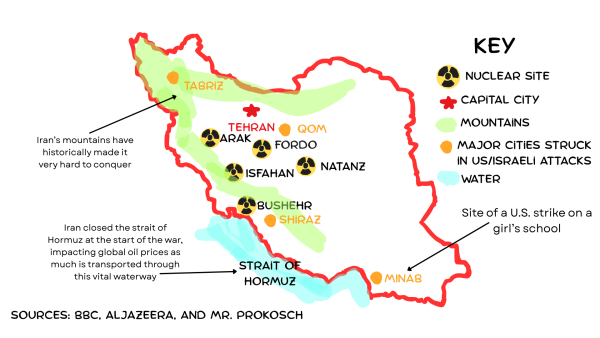
Yet on the same day Khamenei was killed, a U.S. missile strike on a girl’s school in Minab, Iran, killed at least 175 people, most of them students.
And while this conflict may seem far away from us here in New Hartford, students still have opinions on it.
“The average American should definitely care about this war, or any wars our country is involved in,” argues Aahana Rustagi, a senior at New Hartford High School. “You live here, you contribute to the economy, you’re able to take the freedoms this country has to offer for granted.”
“I believe that wars are justified when humanity and security of freedom is threatened,” said Hailie Kress, a junior at New Hartford High School.
Aahana also drew a distinction between just and unjust wars.
“I think war can be justified, in history we’ve seen revolutions and wars for independence, or to end authoritarian rule so of course [war] can be [justified], but not all wars. [War] can be a last resort sometimes as well, but there’s just so much to think about like civilian lives, resources and cost, escalation, etc,” she said.
But how does Operation Epic Fury compare to past conflicts?
“There are two different scenarios,” Mr. Prokosch said, a global history and A.P. European History teacher at New Hartford. “Is the U.S. seeking regime change, the installation of a democratic system or a resurgence of the Pahlavi family? It’s also in U.S. interests to get more oil. Is this similar to the U.S. war in Iraq? It’s possible, I’m not sure I can say that yet, but to me that’s the closest historical precedent.”
Hailie also referenced past historical events, pointing to them as justification for U.S. involvement in Iran.
“I would bring up the points that Iran had been a problem over the last forty-seven years, whether it was holding hostages, attacking US forces in the Middle East, bombings and more nuclear issues, so cracking down on this issue and hopefully demoting Iran to prevent these events from happening in the future is probably more beneficial to the security and peace of the world,” she said.
Following the Islamic Revolution in 1979, Iran did take Americans hostage. Iran’s government has financially backed terrorist groups such as Hezbollah and Hamas across the Middle East. And according to an investigation by the International Atomic Energy Agency, Iran’s government worked towards developing a nuclear weapon for decades in what was known as “Project Amad”. There is still concern regarding Iran’s nuclear capabilities to this day.
Per a Pew Research Center poll published in March 2026, a majority of Americans object to the war in Iran. A majority of the respondents to the survey believe that the war will drag on, and that it makes America and the world less safe, contrary to what the government argues.
“The regime already had missiles capable of hitting Europe and our bases, both local and overseas, and would soon have had missiles capable of reaching our beautiful America,” President Trump said in a speech on March 2nd. This claim has been disputed by the Defense Intelligence Agency.
“Reasons for opposing the war I would say are obviously civilian risk, escalation. I’ve heard that there’s a lot of issues with trade, or concerns that trade will be made more difficult because of the war, and financial issues (oil and energy sources),” Aahana said.
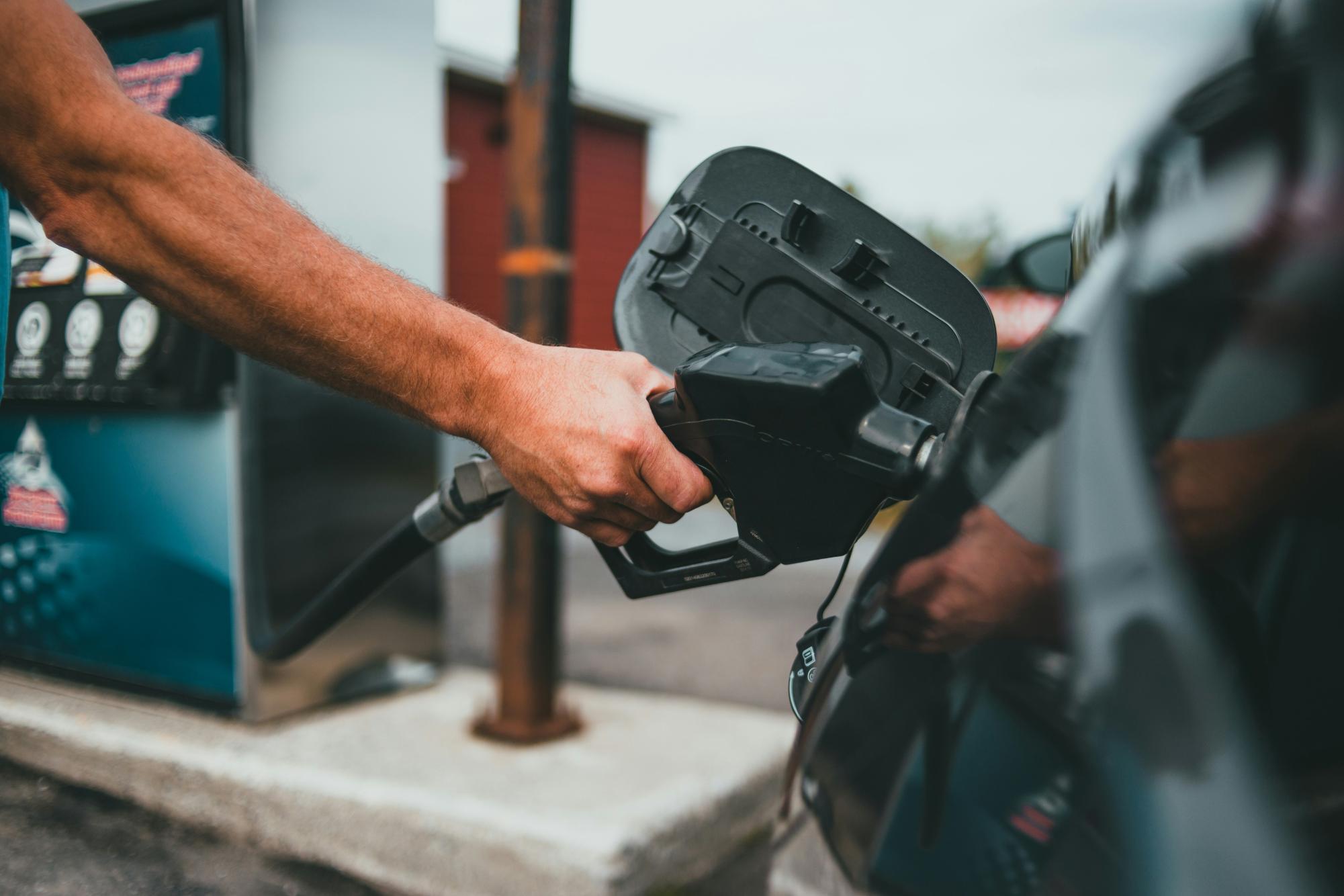
The war in Iran has led to civilian deaths, including those of women, children, journalists, and healthcare workers. According to War Secretary Hegseth’s congressional testimony on May 12th, Operation Epic Fury has cost American taxpayers $29 billion, and closures of the Strait of Hormuz caused by the war have contributed to a spike in gas prices.
“[Gas prices] are high today and could possibly get higher without a doubt as predicted, but I believe that gas should not get any higher than American society as a whole can afford, because it will then lead to a crippling in our economy as a whole,” Hailie said. “When I believe too much has gone too far is when gas prices reach well above $5 per gallon, because it becomes virtually unaffordable.” Hailie noted that gas prices surged past $5 per gallon under the Biden administration in 2022, fuelled in part by the Russo-Ukrainian war.
According to Mr. Prokosch, access to oil has influenced U.S. foreign policy regarding Iran in the past.
“The United States had a fairly close relationship with Iran under the Shah. It was mutually beneficial – the U.S. gave Iran access to military technology in exchange for more oil rights,” Mr. Prokosch said. “However, following the Islamic Revolution, the United States reevaluated its allies in the Middle East, it’s closer to Israel because of that. To me that’s the main historical context, a shift from a government that was pro-U.S. to one that was anti-U.S.”
Iran’s longstanding anti-American position will likely make negotiations harder, Aahana believes.
“I would expect things to get worse before they get better,” she noted. “Yes, there are possible negotiations in the works, but there’s no guarantee [the negotiations] will work, and there’s been recent pressure about increased attacks and bombing if the resolution doesn’t work.”
And while Aahana and Hailie’s opinions regarding the war are different, both agree that Americans can find common ground on this topic. Hailie mentioned Americans being able to join together in support of the military and rally around “killing nuclear threats and potential world danger”; Aahana said that despite growing partisan divides, “of course [Americans] want to protect and help our country […] people want to protect our troops.”
And while the Iran war may seem like uncharted territory, Mr. Prokosch cited several historical parallels to Operation Epic Fury besides the war in Iraq.
“I think it’s similar to Churchill’s failed attack on Gallipoli, World War One […] Churchill assumed that the Ottoman Empire would not be capable of responding to a Western army, which proved very, very wrong,” he said. “I think there are some politicians in the U.S. government who think Iran is less able to defend itself than it actually is: it is very well-defended geographically, historically, Iran is not a country you want to touch. Exit plans matter – there needs to be clearly defined parameters as to how willing you are to get involved in a war, because then it can prove to not only be bloody, but also expensive for a country that’s already in debt.”
As the war in Iran continues, New Hartford students and Americans as a whole will no doubt bear these lessons in mind.